
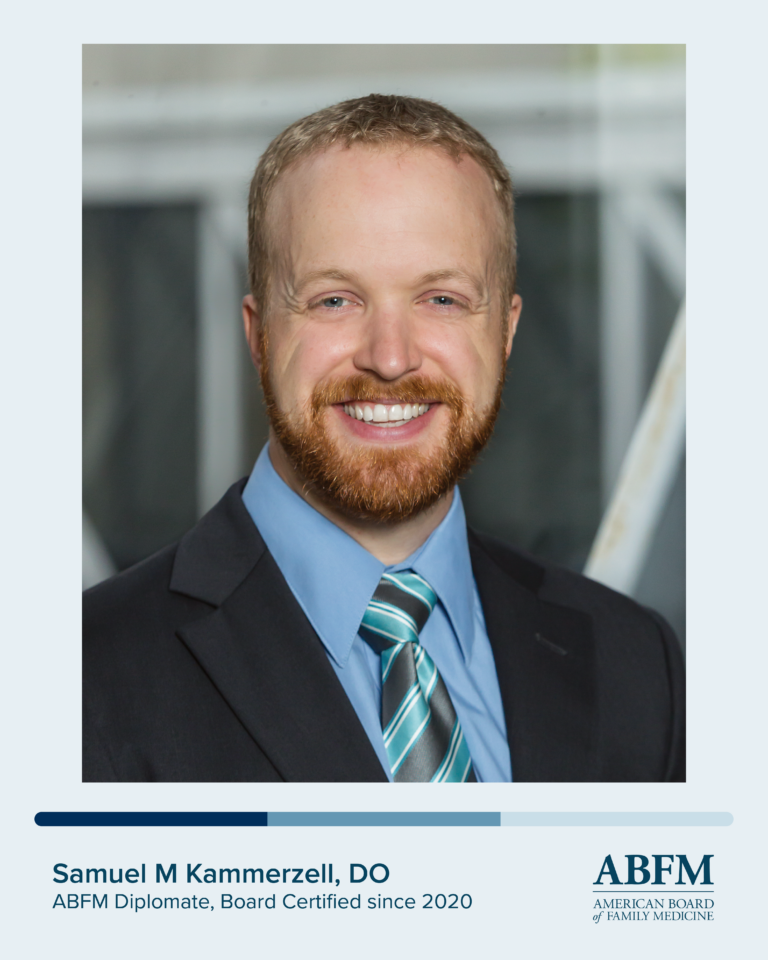
About this article: A peer-to-peer practice spotlight. Dr. Sam Kammerzell, an ABFM Board-Certified family physician in Tulsa, Oklahoma, reviews cancer screenings at the start of every visit. He shares how he built the habit into his workflow, handles patient pushbacks, and why he considers the extra minute worth it. Look here for ideas you can use in your own performance improvement activity.
Anchor the habit to the start of the visit
Before Dr. Kammerzell turns to the reason a patient came in, he reviews where their screenings stand: mammograms, colonoscopies, and PSAs. Some healthy patients visit only once a year, so each appointment is the chance to cover these screenings. Patients learn the rhythm of the visit: screenings first, then the main concern.
Build it into the workflow
Dr. Kammerzell keeps screening status at the top of his note. When he opens the chart from the last visit, he can see what was completed and what’s still due.
His medical assistant is part of the routine too. She raises the importance of screening while rooming the patient, so by the time he walks in he already knows how the patient responds and can pick up from there.
Take the extra time
Dr. Kammerzell is candid that the habit takes longer. “It might be a little bit more work, an extra minute on each patient, but it’s worth it in the long run,” he says. The cost shrinks over time. The next year, the chart already shows which screening a patient skipped, such as a colonoscopy, and he updates it as he goes.
An attending in residency reminded him, “It’s not about numbers, it’s about lives.” As he puts it, “It is extra work, but it’s also our responsibility to be doing this for patients.”
Several women in his practice this past year had breast cancer caught early. Their treatment was a lumpectomy and a little radiation, with no chemo and no radical mastectomy. “Even if you only catch one out of 100, that’s a life changed,” Dr. Kammerzell says.
He’s also seen the other side, especially with colon cancer, which often has few symptoms and can already be stage 4 by the time it’s found. “Catching things early is so much better for everyone,” he says, “for the patient, their family, everybody involved.”
Adjust when patients push back
The habit meets resistance, and Dr. Kammerzell treats it as information. Mammograms can be painful. Colonoscopies draw the most pushback, because patients dread the prep or have heard how bad the mixture tastes. For patients who won’t schedule one, he points to an at-home stool test as a decent alternative. It isn’t as good as a colonoscopy, he says, but more people are willing to do it.
Some of his patients travel in from outlying cities and towns, and a few would rather skip screening altogether. Most, he says, recognize why screening matters, often because they know someone who has had cancer.
“If people are constantly rejecting it, then we’re doing something wrong, that we’re not communicating it well,” Dr. Kammerzell says. He and his medical assistant have worked on better ways to present screenings, and he makes a point of answering questions, clearing up misunderstandings, and easing fears. Explaining how much simpler treatment is when cancer is caught early has moved some women to say, “Okay, I’ll get the mammogram then.”
Let the habit build trust
Over time, patients see that Dr. Kammerzell wants what’s best for them. He often hears, “Doc, whatever you say is what I’ll do.” He finds that trust humbling and wants to honor it. He keeps one test in mind: “If this person is my family member, what would I do? What would I be telling them?”
Start building yours
Dr. Kammerzell’s advice to early-career Diplomates and residents is to begin now. “Build good habits now, because that’s what you’re going to continue to do,” he says. If you want to try it in your own practice, here are a few ways to start:
- Pick one routine task and do it first at every visit.
- Put the reminder where you’ll see it, such as the top of the note.
- Share the first step with your medical assistant or care team.
- Budget the extra minute, and expect it to shrink as the chart fills in.
- Watch for pushback, and adjust how you explain it
The American Board of Family Medicine would like to thank Dr. Kammerzell for his commitment to the specialty of family medicine and to his patients.