
New to the 5-Year Cycle? How Deferred Questions Affect Your Longitudinal Assessment.
The longitudinal assessment gives you the flexibility to answer 25 questions each quarter whenever and wherever it works for you. That flexibility has limits, though, and it helps to know them from the start. Here's what Diplomates new to the 5-Year Cycle should know about questions that go unanswered.
October 8, 2026
If you’re new to the 5-Year Cycle, the secure Family Medicine Certification Longitudinal Assessment (longitudinal assessment) may be different from how you’ve maintained your board certification in the past. Instead of taking a traditional one-day exam at the end of a cycle, you’ll answer 25 questions each quarter over time. Your assessment timeline begins on January 1, of the year you enter the 5-Year Cycle, so understanding how the timeline works, and how deferred questions can affect it, is important.
One of the benefits of this approach is flexibility. If life or practice gets unusually busy, you can defer questions rather than trying to fit them in when you don’t have the time.
What does it mean to defer questions?
Each quarter, 25 questions become available. If you don’t open a question during that quarter, it is considered deferred and will become available again in a future quarter.
Deferring questions doesn’t mean you’ve failed or fallen out of the longitudinal assessment. It simply means your timeline for completing the assessment changes.
If you answer all 25 questions as they become available in every quarter from the start, you can complete the 300-question assessment at the end of year three. If you defer questions along the way, your timeline for completion will shift to year four.
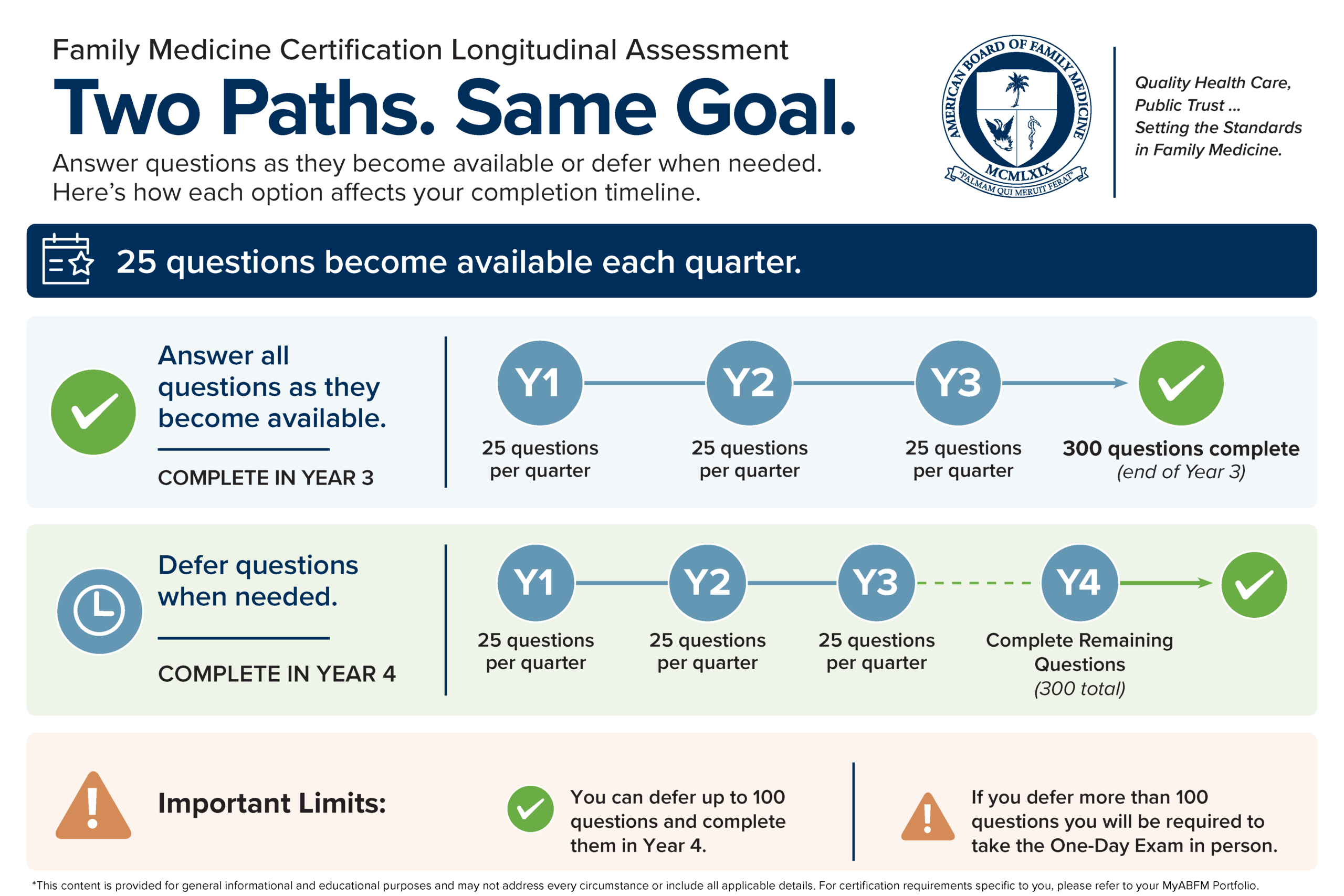
Answer all questions as they become available → complete in year three.
Defer up to 100 questions when needed → complete in year four.
Flexibility when you need it
Family medicine doesn’t always fit neatly into a quarterly schedule. An unexpected life event or demanding period in practice can make it difficult to keep up. Deferred questions give you some flexibility without requiring you to make up those questions immediately.
The main thing to know is that deferring questions changes your completion timeline, not your ability to continue with the longitudinal assessment.
There is one important limit: If you defer more than 100 questions, you will not be able to complete the full 300-question assessment within the four-year requirement window.
Key Takeaway: the longitudinal assessment is designed to give you flexibility. If you need to defer questions, you have the option to do so. Just know that your assessment will then be completed in year four rather than year three.
To learn more about how your exam fits into the 5-Year Cycle, click here.