Every August 31, International Overdose Awareness Day brings communities together to remember lives lost and confront one of the most persistent public health challenges of our time. This year’s theme, “25 Years On. Still Needed,” is a reminder that awareness alone is not enough. The question the specialty of family medicine has always been positioned to answer is what comes next.
For many family physicians, it is probable that someone in their patient panel has survived an overdose. Research suggests up to 5% of primary care patients have opioid use disorder, ¹ yet fewer than one in 10 family physicians prescribe buprenorphine. ² Many of these patients first encounter the health care system in crisis, when Emergency Medical Services (EMS) personnel reverse an overdose with naloxone (Narcan). If the patient survives, the question becomes: what happens next?
For Dr. Angela Cornelius, that question became impossible to ignore.
Surviving is Just the Beginning
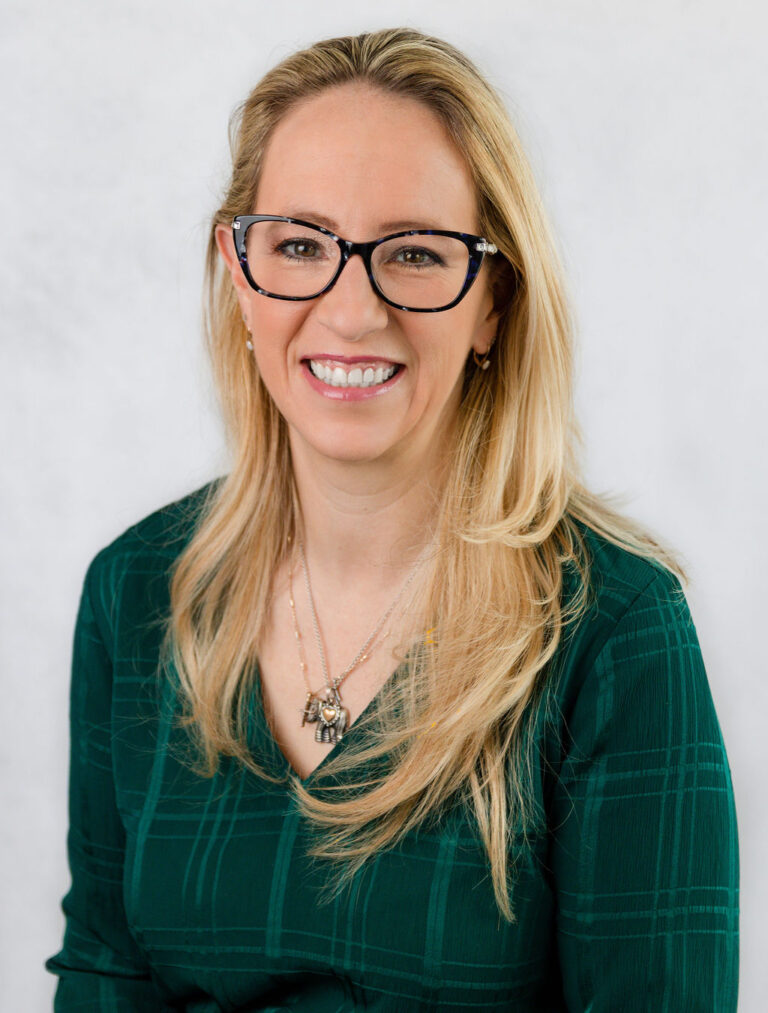
Dr. Cornelius is a board-certified family physician and emergency medicine physician serving as associate medical director for the Fort Worth Office of the Medical Director and the Fort Worth Fire Department. Cornelius oversees the credentialing and clinical education of roughly 2,000 first responders across 14 agencies. The work gives her a perspective most family physicians never see: EMS personnel often interact with patients after naloxone has reversed the overdose but are seldom present to witness any benefits of longer-term treatment.
Her role as medical director gave Dr. Cornelius access to data that brought the problem into focus. Fort Worth EMS administered between 70 and 100 doses of Narcan every month. People were surviving. And then, as far as the record showed, almost nothing happened next.
The moments after an overdose reversal are often treated as an ending of care. Dr. Cornelius wondered whether they should be viewed as a beginning.
“I want to know of all these Narcan administrations, where do these patients actually fall? Because I want to know what we could actually do.”
It is the same curious instinct that often draws people to the specialty of family medicine in the first place. You notice something that concerns you and you can’t let it go.
Because of her concerns, Dr. Cornelius started a community Narcan distribution program, putting boxes of the potentially life saving drug into the hands of Fort Worth residents, no questions asked. She spent three years working toward getting buprenorphine on every Fort Worth Fire Department ambulance, knowing that for patients in withdrawal, access to medication in the field could be the difference between treatment today and another crisis tomorrow. Her most advanced field teams are already carrying it. Full deployment is targeted for this fall. But to justify that at scale, she needed to know how many patients were actually in withdrawal when EMS arrived.
Finding the Gap After Reversal
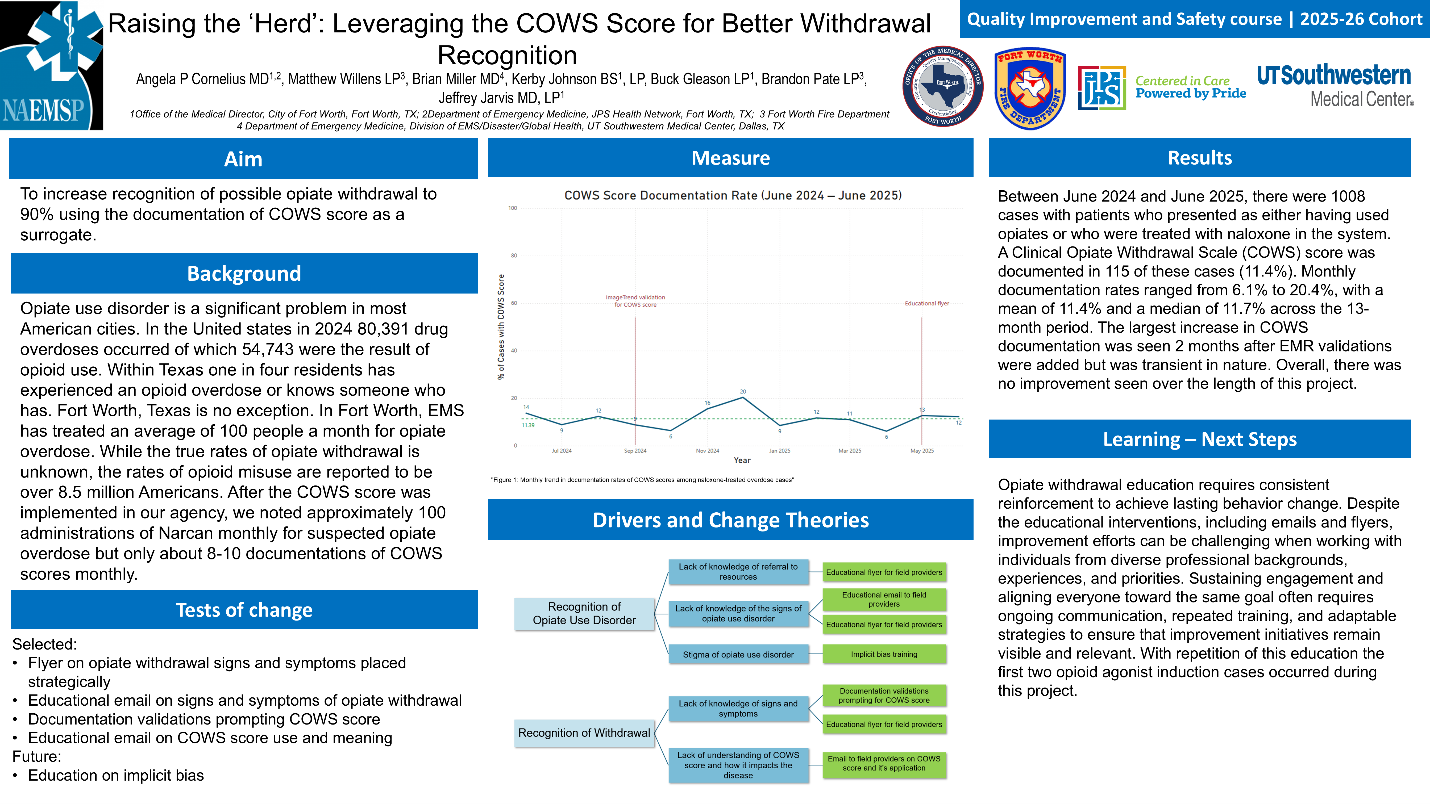
When Dr. Cornelius examined local EMS data, she noticed a significant gap in the documentation. The Clinical Opiate Withdrawal Scale, known as the COWS score, helps evaluate opioid withdrawal severity and guide treatment decisions, including whether administering buprenorphine may be appropriate. The data confirmed that among roughly 100 Narcan administrations each month, the COWS score was only documented approximately two or three times. For Cornelius, the low documentation rate raised a larger question: Were clinicians missing opportunities to identify patients who might benefit from treatment?
To find out, Dr. Cornelius enrolled in a year-long quality improvement course and built a formal performance improvement project around it. Her team started with education: flyers, emails, and direct presentations to paramedic teams. Documentation improved modestly. They then built electronic medical record (EMR) prompts to remind personnel to complete a COWS score when appropriate, and documentation rates increased significantly.
During the project, the Fort Worth Fire Department absorbed EMS operations from MedStar (a mobile medical healthcare service), requiring a major system transition. During the transition, EMR custom prompts stopped functioning and documentation rates fell again.
“The computer guy is still rebuilding my opiate validations,” she said, with the kind of laugh that only comes from two years of following up on the same EMR update ticket.
Across 1,008 cases captured between June 2024 and May 2025, a COWS score was documented in 115 instances, an overall rate of 11.4%. The numbers did not move the way Dr. Cornelius wanted. The project did not end the way she had hoped.
She kept going anyway. Two patients were started on buprenorphine in the field during that period, the first such cases in the Fort Worth system. For Dr. Cornelius, those cases represented the true purpose of the project. The goal was never simply to improve documentation. It was to identify patients at a moment when post-rescue treatment might be possible.
That is what performance improvement looks like most of the time. Not a clean before-and-after, but a stubborn push against a problem that doesn’t cooperate, with small wins that matter even when the data isn’t overwhelming. A life saved matters. Family physicians know this. Sometimes when a broken system does not cooperate, our ingenuity inspires us to look for a better solution.
The Same Hurdles, A Different Door
The patients Dr. Cornelius is trying to reach through EMS are often the same patients seen later in clinics, urgent care centers, and family medicine practices. A patient who receives Narcan in the field may appear in a family medicine office weeks later for diabetes management, a medication refill, or an annual wellness visit. The recent overdose and recovery may never come up in patient-physician conversation unless someone asks.
Surviving an opioid overdose is seldom evidence that the victim is ready to enter ongoing treatment. A patient who declines help in the field may be more receptive in a primary care office. But if no one opens the conversation, both acute incident and follow up opportunities can be missed.
“People are oftentimes very embarrassed about substance use. Put up a discreet sign. A no-judgment zone. You just make it clear that the door is open.”
Dr. Cornelius encourages every family physician to screen for opioid use disorder routinely and become familiar with prescribing options for buprenorphine. The conversation does not have to be long. It does not have to solve everything in one visit. It just has to happen.
Dr. Cornelius is honest about what it took to get there herself.
“Hindsight’s 20/20,” she said. “If I’d stopped and looked more deeply or asked a few more questions, there’s probably stuff I could have found that might have benefited them greatly, instead of being so worried about treating their diabetes.”
She is not saying that to judge anyone. She remembered the pressure of the 15-minute visit and how easy it can be to move to the next urgent concern.
Performance improvement gave Dr. Cornelius a practical way to look more closely at missed opportunities, test what might help, and keep learning when the work did not go as planned. For family physicians, the lesson is simple: when a patient comes back through your door, open the conversation and make help available.
“Offer it. Maybe they don’t take it today. But you unlock the door. And maybe they start thinking about it.”
¹ Johnson EA, et al. Prevalence and treatment of opioid use disorders among primary care patients in six health systems. Drug Alcohol Depend. 2020;207:107732. As cited in: Annals of Family Medicine, July/August 2025.
² Tong ST, et al. Buprenorphine provision by early career family physicians. Ann Fam Med. 2018;16(5):443-446.
The American Board of Family Medicine thanks Dr. Cornelius for sharing her story with us, and the team she works with as they continue this noble cause.